
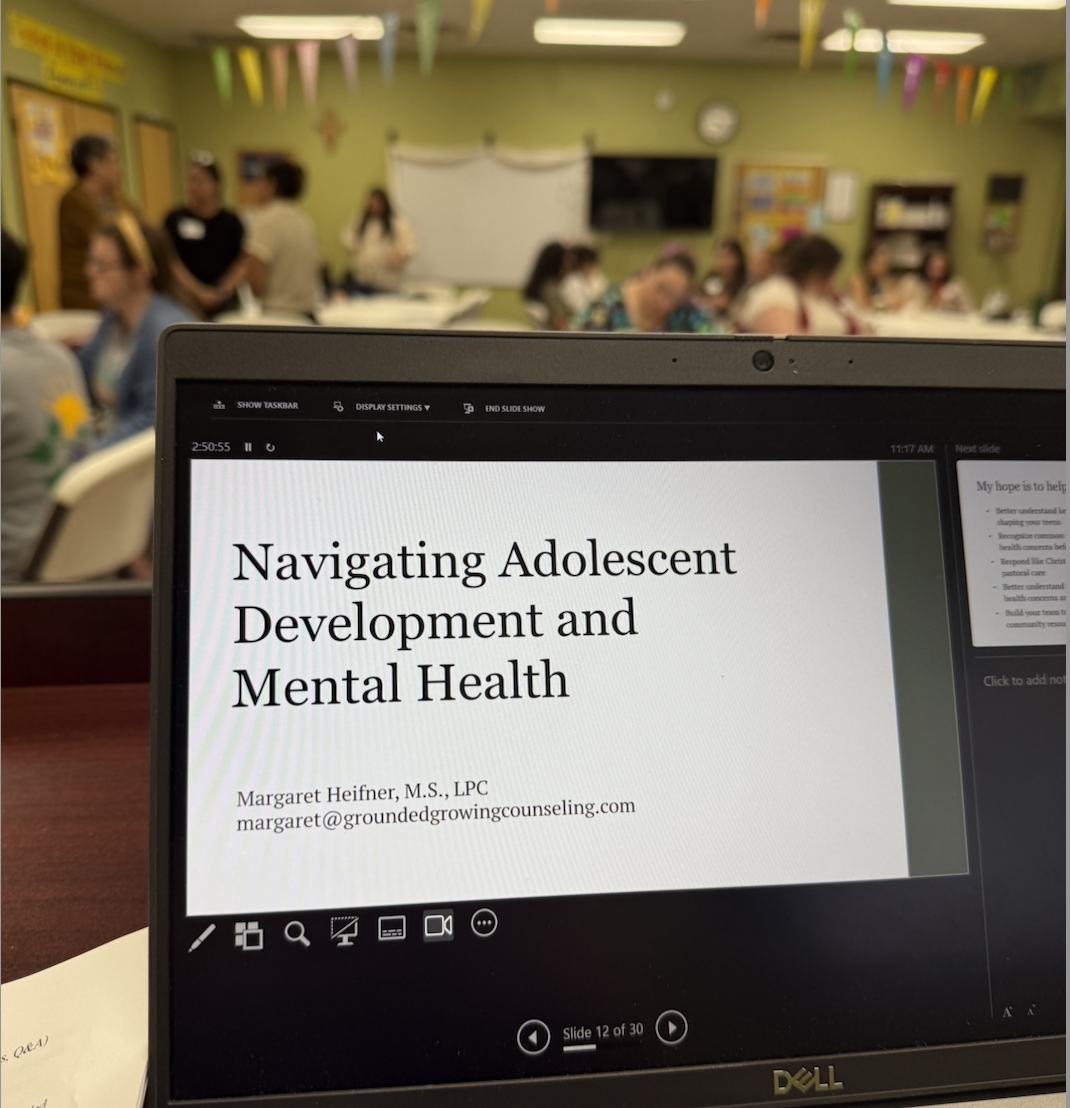
Earlier this month, I stood in front of a room full of youth ministers and their volunteers, teaching them how to recognize and respond to mental health challenges in the students they serve.
Watching them lean in as we talked through warning signs and pastoral boundaries, I felt a familiarity I didn’t expect, and I realized: I never really left my work in ministry. My work now is just a continuation of ministry in a different way.
A Full-Circle Moment
When I graduated from Texas A&M University (WHOOP!), I found myself torn between youth ministry and counseling. Hesitant to jump straight into more schooling and with a great offer on the table from a parish, I chose youth ministry.
For two years, I served middle school and high school students. It remains some of the most meaningful work I’ve ever done, and it was also where I first saw up close just how much teenagers were struggling. I watched the teens in my youth group carry heavy burdens like anxiety, family stress, quiet depression, questions of self-worth, eating disorders, and emotional pain. I cared deeply about these challenges, but I wasn’t trained how to navigate them. I could show up, listen, sit in the hard moments, and pray with them. But there were moments I knew I was standing at the edge of something that needed more than what I was trained to give.
Recognizing the gap between what I could offer and what I knew my students needed is when the pull toward counseling stopped being a cautious “maybe” and became a confident “yes.” I still loved ministry, but I knew I was being called to serve differently. What I didn’t expect was just how beautifully these two worlds would eventually intersect.
The Conversation We Shared
During our training session, we focused on three core areas:
Understanding adolescent development so leaders can distinguish between what’s developmentally common versus clinically concerning.
Recognizing early warning signs of a student struggling with their mental health.
Responding with genuine pastoral care and compassion without stepping into a role that isn’t theirs to fill.
Some of the richest moments came through the conversations we had and the life-giving energy in the room. We dove into the unique pressures Gen Z navigates and the incredible strengths they possess because of it. We explored practical questions, such as how to refer a student to counseling in a way that communicates care instead of rejection and when to involve parents in a way that honors the relationship with the student. They also left with a practical understanding of the mental and emotional realities showing up in the teens they serve, the language to respond confidently when a struggling student confides in them, and relief in knowing their role as a caring adult and spiritual leader.
My Heart for This Work
I was incredibly honored to give this ministry training because I remember exactly what it felt like to sit where these leaders are: deeply invested, genuinely called, and often under-resourced for the mental health realities showing up in ministry every week. I didn’t receive a framework for where pastoral care ends and clinical care begins. At 23, I didn’t know how to enter those conversations in a grounded, clear, confident way.
But I firmly believe that professional and spiritual support are not in competition. They need each other and can work hand in hand. Faith communities are some of the most common places people first search for support. We need leaders and communities who can offer spiritual presence and formation and say, “Let's get you some extra support, too." Helping ministries integrate this into the way they care for people is one of my greatest passions.
Today, my experience in both parish ministry and clinical counseling allows me to bridge the gap between mental health and faith for people across many stages of life, including youth leaders serving Gen Z through heavy burdens, college students navigating identity away from home, couples building a foundation for their family and walking through the challenges of life together, and young adults figuring out faith and independence at the same time.
Every training and talk I give is deeply personal to me, and a privilege, because I carry the heart of my work as a ministry into each opportunity. Bridging the space between emotional health and faith is my passion, and I’m grateful to serve at that intersection. As a speaker, I tailor every session to the specific ministry and life stage of the group I’m working with, whether that’s a single training for a ministry team, a talk for a community night, or an ongoing speaking partnership with your church or organization.
Bringing This to Your Community
Whether it’s helping a youth ministry team recognize the mental health needs of their students, walking college students through anxiety and perfectionism, guiding couples through boundaries and family of origin, or speaking to any group navigating the intersection of faith and emotional health, I’d love to partner with you and bring that conversation to your school, church, or organization. Connect with me to explore what speaking event we can bring to your community!